For about three months last year, I wrote every single day. Didn’t miss once. I had a streak going and I was determined not to break it.
Then I stopped. On purpose. I decided to try the opposite approach. Write when I felt like it. No schedule. No guilt. Complete freedom.
Both experiments taught me something. Neither was what I expected.
I started the daily writing habit because I kept reading that consistency was the key to everything. Every craft book, every successful author interview, every writing forum seemed to agree: writers write. Every day. No excuses.
So I committed. I set a minimum of 200 words, which felt achievable even on bad days. I tracked my streak in a little app that gave me a satisfying checkmark each time I logged my words.
And it worked. Sort of.
I wrote more than I had in years. Stories that had been stalled for months started moving again. I finished a draft I’d been picking at forever. The momentum was real. Once I sat down and started, the words usually came.
But something else happened too. Something I didn’t notice at first.
Writing started to feel like a chore. Not every day. But more days than I wanted to admit. I’d sit down at 10 PM, exhausted, knowing I still needed my 200 words before I could sleep. And I’d grind them out. Check the box. Feel relief that it was done.
Relief. Not satisfaction. Not joy. Just relief that I’d maintained the streak.
The streak itself became the point. Not the writing. Not the stories. The number in the app.
I also noticed I was avoiding harder writing tasks. If I had a difficult scene to figure out, I’d write something easier instead. Journal entries. Freewriting. Anything to get my words counted without actually wrestling with the problems in my actual project.
By month three, I was consistent. I was also kind of miserable. The thing I loved had started to feel like an obligation. And the quality of what I was producing had flattened out. Lots of words. Not much life in them.
I wish I could say I made a thoughtful decision to end the experiment. Really, I just got sick one week. Fever, couldn’t get out of bed, definitely couldn’t write.
The streak broke. And instead of the devastation I expected, I felt something closer to relief. That same relief I’d been feeling every night when I finished my words. Except bigger.
When I recovered, I didn’t restart the streak. I decided to try something different instead.
The new approach had no rules. I would write when inspiration struck. When I genuinely wanted to. When a story was calling to me so strongly that sitting down felt like a gift rather than a duty.
This, I thought, would bring back the joy. I’d reconnect with why I started writing in the first place. I’d produce work that mattered because it came from genuine creative desire, not obligation.
Here’s what actually happened.
Week one: I didn’t write at all. I kept waiting to feel like it. The feeling didn’t come.
Week two: I wrote once. For about twenty minutes. It felt nice, actually. Low pressure. Then I didn’t write again for another five days.
Week three: I started to get anxious. I hadn’t touched my projects in weeks. The characters were fading in my mind. The threads of the stories were getting tangled. I’d sit down occasionally, but I’d spend more time rereading old work than creating new work.
By month two, I’d written maybe 2,000 words total. Compared to the 20,000 or so I’d written in a typical month during my streak.
The freedom I thought I wanted turned out to be a different kind of trap. Without any structure, without any external reason to show up, I just didn’t. The resistance was always stronger than the inspiration.
And the guilt came anyway. Different from the streak guilt, but just as present. I’d think about my stories and feel bad that I wasn’t working on them. But not bad enough to actually sit down. Just bad enough to feel vaguely disappointed in myself all the time.
Thinking back on both experiments, I can recognize now what each one was teaching me.
The daily writing showed me that consistency creates momentum. There’s real power in showing up every day. The stories stay fresh in your mind. The characters stay close. You don’t have to spend the first twenty minutes of each session remembering where you left off.
It also showed me that I can write even when I don’t feel like it. That waiting for inspiration is often just waiting. That the muse, if she exists, tends to show up after I’ve started rather than before.
But it also showed me that consistency without flexibility becomes rigidity. That optimizing for the streak can mean optimizing for the wrong things. That the number in the app is not the same as the work itself.
The freedom experiment showed me that I need some structure. Left entirely to my own devices, I will choose comfort over creation almost every time. Not because I don’t want to write. Because wanting isn’t always enough to overcome inertia.
It also showed me that guilt is not a good motivator. The vague, chronic guilt of not writing was somehow worse than the acute, nightly pressure of needing to hit my words. At least with the streak, I knew what I had to do. Without it, I just floated in a fog of should-be-writing that never resolved into actual writing.
But the freedom experiment also showed me what genuine desire to write feels like. On the few occasions when I did sit down, truly wanting to, the writing was different. Looser. More surprising. I wasn’t grinding toward a word count. I was exploring.
That feeling had gotten buried during my streak. I’d forgotten what it was like.
I don’t write every day anymore. But I also don’t just wait until I feel like it.
What I do now is somewhere in between. And honestly, it’s still evolving. I haven’t figured out the perfect system. I’m not sure there is one.
But here’s roughly what works for me right now.
I write most days. Maybe five out of seven. I aim for consistency but I don’t track streaks. If I miss a day, I miss a day. It doesn’t erase anything. It’s not a failure. It’s just a day I didn’t write.
I have a loose minimum, but it’s flexible. Some days I write a lot. Some days I write a paragraph. Some days I just open the document and think about the story without adding any words. All of those count. I’m trying to stay connected to the work, not hit arbitrary targets.
I give myself permission to skip when I really need to. When I’m exhausted. When life is overwhelming. When my brain genuinely has nothing to offer. I trust that I’ll come back. And so far, I always have.
And I try to notice when writing starts feeling like pure obligation. When the joy drains out completely. That’s a signal to ease up, not push harder. To remember why I’m doing this in the first place.
Here’s what I keep thinking about.
Too much pressure kills the thing you love. It turns play into work, exploration into production, art into obligation. I’ve felt that death happening. It’s quiet and gradual and you don’t always notice until the joy is already gone.
But too much freedom kills it too. Just differently. Without any structure, the work drifts away. You think about it fondly. You intend to get back to it. But intentions don’t become stories.
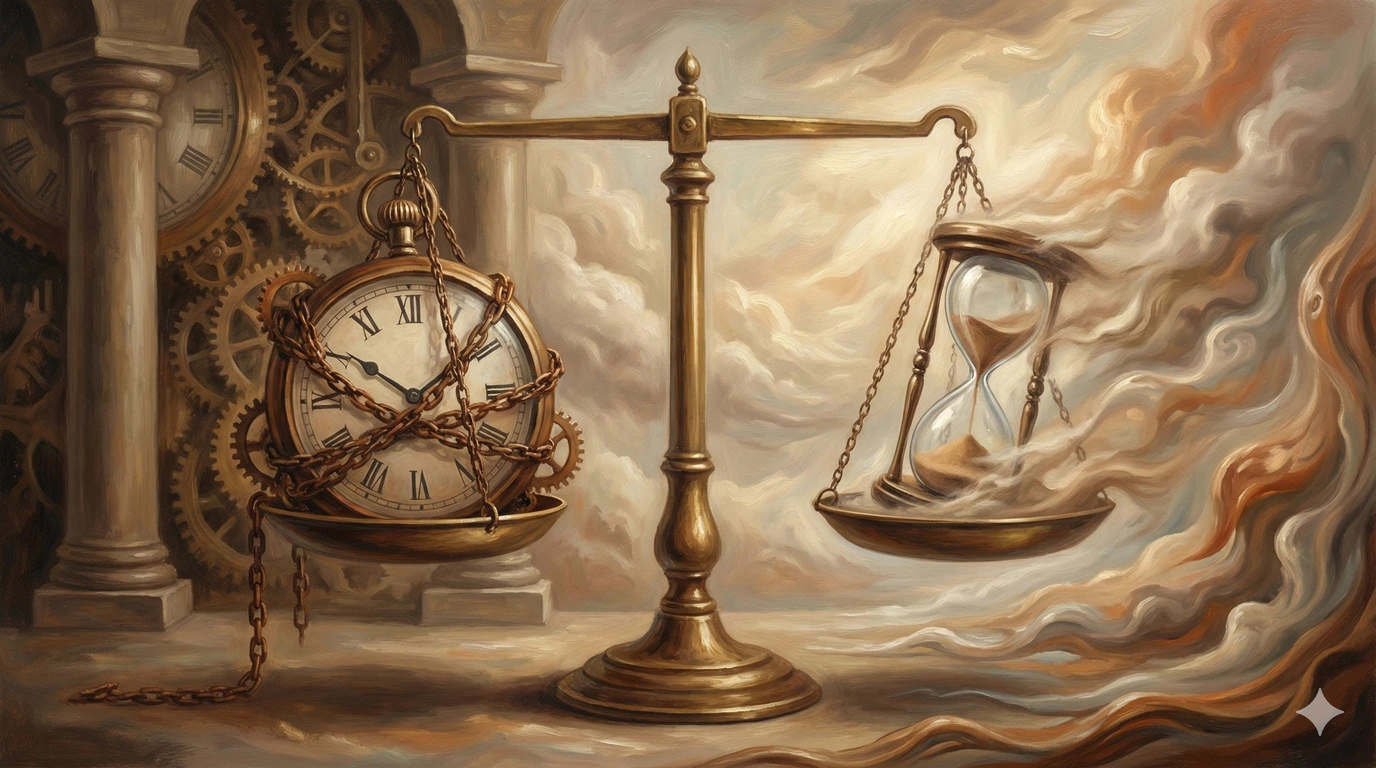
I think what I’m looking for is some kind of middle path. Enough structure to keep me showing up. Enough freedom to keep the work alive.
That balance point is different for everyone. And it probably shifts over time. What works during a busy season might not work during a calm one. What works at the beginning of a project might not work at the end.
So I’m trying to hold it all loosely. To pay attention to what the work needs and what I need. To adjust when something isn’t working instead of grinding forward out of stubbornness.
I don’t have this solved. Some weeks I write consistently and it feels sustainable. Other weeks I push too hard and feel that old resentment creeping back. Other weeks I’m too lenient with myself and the stories start to fade.
I’m trying to get better at reading the signals. At knowing when I need discipline and when I need rest. At trusting that one day off won’t turn into permanent abandonment.
It’s a practice, I guess. Not just writing, but figuring out how to keep writing. How to make it sustainable across months and years. How to build a relationship with the work that doesn’t burn out or fade away.
I don’t think there’s a formula. Just ongoing attention and adjustment.
I keep wondering: what is the writing actually for?
During the streak, it was for the number. For the checkmark. For being able to say I wrote every day.
During the freedom experiment, I’m not sure it was for anything. It just floated, disconnected from any purpose or direction.
Neither of those feels right.
I think the writing is for the stories. For the characters who want to exist. For the satisfaction of making something where there was nothing before.
When I remember that, the questions about schedule and structure matter less. Show up enough to serve the work. That’s it. However that looks for you, in this season, with this project.
What about you? Have you experimented with different approaches to consistency? I’m curious what you’ve found. Whether you thrive with daily habits or need more flexibility. Whether you’ve found your own middle path or you’re still searching.
I suspect most of us are still searching. And that might be okay.